Care of Container Plants
At Plantations, we use a commercially available soil-less mix, which retains the water, nutrients, and oxygen needed for plant growth in our smaller container plantings. We use a 1:1 ratio of compost and soil-less mix for our larger wooden bin planters. Because the mix contains no nutrients, fertilizing is a regular part of our regimin. During summer, we apply a 20-20-20 liquid fertilizer weekly to our container plantings, and we mix a dry, organic, slow release fertilizer into the wooden bins. All container plants require frequent watering. Pots with established plants exposed to full sun and desiccating breezes may need watering as often as twice a day. Plants should be gradually "hardened off" to prevent sun and windburn prior to being put outside in the spring.
Design
Whether you are working with large containers that can accomodate several kinds of plants, or arranging multiple pots of individual plants, it is helpful to consider a few basic elements of design.
Color is what our eyes see first, so it is one of the most important qualities to consider when selectin gand designing with plants. A combination of cool colors, such as blue and green, create a subdued, subtle effect, while red, orange, and yellow hues convey
|
 |
|
a sense of brightness and flamboyance. Monochromatic schemes are created when plants in various tints and shades of one color are combined. Complementary colors are opposite each other on the color wheel. When combined, these colors become more intense, and make for a vibrant planting scheme. Analogous schemes are created when three, four, or five adjacent colors on the color wheel are combined. For example: red, purple, and blue; or yellow, orange, red, and purple.
Form, or the three-dimensional shade of a plant, is another important consideration for creating satisfying
|
plant compositions. There are five general categories of form - upright, rounded or mound forming, arching or rosette, prostrate or trailing, and irregular. Tall dense plants with upright, rounded, or irregular forms are often useds as fillers, bridging the gap between arching and rosette forming plants that stop the eye as focal points in a composition. Plants with especially large, broad, or colorful leaves create bold accents that provide stunning punctuation in design. Shorter mound-formers are useful as edging plants, creating a solid formation from which taller plants emerge, and concealing their bare stems.
Texture, such as smooth, rough, velvety, or leathery, refers to the surface of quality of the leaves. It can also be used to denote the relative size and number of leaves or flowers in relationship to the size of the plant as a whole. Fine textured plants are those with small and often numerous leaves or flowers. These are useful as edging
|
plants. Conversely, coarse textured plants have relatively large and often fewer leaves and flowers, and result in a plant with a distinct sculptural quality, useful as an accent.
Lines in plant compositions can be vertical or horizontal. Vertical lines are created by strongly ascending leaves and stems. These give the composition a sense of vitality and excitement. Horizontal lines of leaves and stems are calming and to to ground or stabilize a composition. Weeping stems or lines created by arching foliage are elegant and restful. |
 A container garden display which makes good use of color, line, form, and texture! |
| |
Choosing Plants
Putting together a container collection that results in a season-long display of interesting combinations requires some individual creativity and imagination. It helps to choose from a variety of colorful foliage and flowering plants, and those with interesting textures and growth habits.
Tall plants with structural form add a strong vertical line. These plants can be effective singly in a container for dramatic effect, or used in mixed containers as a focal point.
|
|
Tall Plants: (Left) Red leaved amaranth (tallest plant) provides strong, vertical structure in this arrangement of warm, analogous colors. The bright yellow-striped foliage of Sanchezia provides a grounding accent. (Right) Canna 'Pretoria', with its orange flowers and purple stems, is a knockout of unlikely but fabulous colors.
|
| Examples we use at the Plantations include: |
Canna (Canna x generalis): Fast growing, rhizomatous plant grown for its beautiful foliage and colorful clusters of gladiolus-like flowers. Foliage is huge and banana-like, often in bold, dark colors, sometimes striped; it remains beautiful until frost. Blooms throughout the summer.
|
New Zealand flax (Phormium tenax 'Purpureum'): Dramatic, structural foliage plant forming large clumps of deep purple/brown, sword-shaped leaves. Excellent as a specimen in a container, or in mixed arrangements as a focal point. Over-wintered plants will improve in stature in time.
|
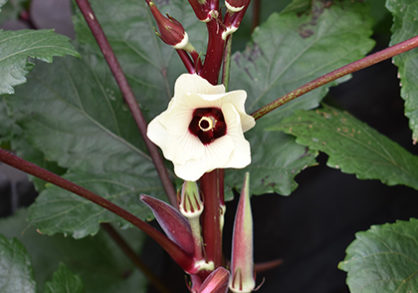
Hibiscus (Hibiscus acetosella 'Red Shield'): Fast growing, shrubby plant grown for its exotic, brilliant burgundy, five-lobed leaves. Good vertical accent. Hibiscus rosa-sinensis is a tropical, ever-blooming shrub grown for its huge five-petaled flowers that bloom in every imaginable color. Good as a specimen, or focal point in mixed containers.
|
Elephant ear (Alocasia esculenta): Dramatic, tropical tuberous perennial with huge lush foliage arising from the base on long stems. Some cultivars, such as 'Protodora Shield' have enormous leaves, up to 3' long. We use 'Black Magic' for its striking velvety, purple-black leaves, which are up to 2' long.
|
Others: Species and cultivars of palm lily (Cordyline),amaranth (Amaranthus), Colocasia, agave, and cycad; golden dewdrop (Duranta erecta 'Golden Edge'), and honey bush (Melianthus major). |
| |
| Filler plants are useful for massing around structural plants in mixed containers, or by themselves as accent plants. Annuals and tender perennials that produce exotic and colorful foliage and/or flowers reliably add color and interest throughout the growing season. Examples we use at Plantations include: |
|
Coleus (Solenostemon scutellarioides): For season-long interest, few plants provide as much variety of brilliantly colored foliage, leaf shape and plant form as coleus. Foliage ranges from velvety deep purple to multi-colored varieties, on plants that can be upright, bushy, or cascading. |
 Filler Plants: (Left) The elegance of a rolled-rim terra cotta pot is enhanced by a monochromatic display featuring the taller anise hyssop (Agastache 'Apricot Sprite') and shorter orange gazanias. (Right) Coleus 'Alabama Sunset' (bottom) and 'Oxblood' (top) |
|
Eucalyptus (Eucalyptus cinerea): Grown as an annual, the silvery-blue foliage provides an excellent accent and filler, contrasting well with almost any color scheme. By over-wintering the plant, it can become an architectural specimen with great effect. |
|
Lantana (Lantana camara): A sprawling, tropical, floriferous shrub grown for its vibrant verbena-like flowers in bright and multi-colored hues. Depending on variety, they can be upright and shrubby or sprawling, weeping, or trailing. |
|
Other: Painted tongue (Salpiglossis sinuata), anise hyssop (Agastache foeniculum), plume flower (Celosia), firecracker plant (Cuphea), blood-leaf (Iresine), shiso (Perilla frutescens), gazania, and fuchsia.
|
| |
| Edging or cascading plants make excellent companions in mixed arrangements. These vigorous growers are climbing, trailing, or cascading-spilling down the sides of containers or weaving through the planting. Well chosen, these plants will tie the container together, soften the edges, and add layers of contrasting flowers and foliage. Examples we use at Plantations include: |
 Cascading Plants: (Left) An attractive arrangement of complimentary colors and contrasting textures in a wooden bin planter, including (upper left) a flowering maple, (upper right) a lime green and yellow coleus, and (lower right) sweet potato vine. (Right) A graceful cascade of Petunia integrifolia. | |
Christmas clover (Alternanthera dentata 'Rubiginosa'): Versatile and colorful plant with dark, burgundy-red leaves that weave through a planting. Good all-season color.
Licorice plant (Helichrysum petiolare):
Vigorous trailing plant with silver foliage that quickly fills in every available space, softening the edges and forming a silvery frame around the container.
Silver plectranthus (Plectranthus argentatus): A vigorous grower with fuzzy, silvery leaves with a purplish cast to the stems. Good contrast color to compliment darker-foliaged plants.
|
| Black-eyed Susan vine (Thunbergia alata): Vigorous yet delicate climber that twines through a container planting adding layers of flowers and foliage. The most common one has bright yellow flowers with dark, almost black eyes; newer mixes now offer shades of red to purple.
|
| Other: Species and cultivars of cup and saucer vine (Cobea), glory flower (Eccremocarpus), morning glory or sweet potato vine (both Ipomea); parrot's beak (Lotus berthelotii), million bells (Calibrachoa), and petuni. |
|